Choosing the right carpet fitter
Reading time:10 minutes
One of the biggest and simplest changes you can make to your home is to update what’s under your feet. Whether you’re replacing draughty wooden floorboards or updating a threadbare carpet with a thick new one, adding a carpet is one of the best ways to refresh a room.

Finding the right carpet fitter for you is key to ensuring the project goes smoothly. We spoke to some of the experienced tradesmen recommended on MyBuilder to find out the key things you should know in order to make the right choice:
- Check their experience
- See what qualifications they might have
- Make sure you’re comfortable with them
- Ensure they are open about the materials they will use
- Get like-for-like quotes and make sure everything is included
- Establish a payment plan
- Check if there will be follow-ups if needed
Keeping these points in mind can help you focus on what to look for when you’re meeting with tradesmen and getting quotes for the work. Carry on reading for more details on how to go about finding the right tradesman for your job.
Check their experience
Compared to some home improvement projects, such as building an extension or rewiring a whole home’s electrics, fitting carpets is a fairly low-impact job. However, just because it is relatively simple, doesn’t mean it should be overlooked when it comes to hiring the right person - you should be on the lookout for a tradesman that comes well-recommended.
Some tradesmen are dedicated carpet fitters who only fit and install carpets. Others tradesmen will do a range of flooring - including installing wood floors, laminate flooring, vinyl flooring, or even tiling. There are also general builders and handymen who will be able to fit carpets.
As with any job, hiring someone who has specific knowledge of your project is ideal. A dedicated carpet fitter will be the person best suited to doing a carpeting job, and will be better placed to deal with any issues and answer any questions you have.
It is vital to check the references of any tradesmen you meet. There are a number of ways you can do this. A simple way is to read feedback on a site like MyBuilder, which allows previous customers to leave reviews of their experience with the tradesman. When you meet with them, they should also be able to show you a portfolio of their work, with pictures of previous jobs. They should also be willing to put you in touch with their previous clients, who can give a personal recommendation. Peter Jewett of LifeStyle Trade Flooring said:
The first thing my customers do is look at the reviews, and look at how long someone’s been doing it. If someone’s only been fitting for a short period then obviously you want to see some work that they’ve done - you should always ask for references. We have a portfolio of all of our work, we’ve got a list of customers who are quite happy to talk to other people.
Peter Jewett, LifeStyle Trade Flooring
See what qualifications they might have
As well as checking their references, don’t be afraid to question the tradesmen you meet about any qualifications they may have, their length of time in the business, or how they’ll approach your own particular job. You can also find out if the tradesman is a member of any trade associations or accreditation schemes. Tradesmen who fit carpets may belong to various organisations. Some you may encounter include:
- The Contract Flooring Association (CFA): Formed in 1974 from three smaller organisations, and taking in tradesmen who work with a variety of floorings such as carpets, timber and vinyl, members of the CFA are vetted before joining to ensure they have a good track record and offer a high standard of service. Members are kept up to date with industry standards, and abide by a contractor’s code of conduct
- The National Institute of Carpet and Floorlayers (NICF): Formerly the National Institute of Carpet Fitters, formed in 1979, this body promotes excellence in the field and upholds the British Standards Code of Practice for the installation of textile floor coverings. Members must provide references and pass an exam to be admitted, and can progress to be “Master Fitters”.
- The CFA and NICF collectively established the Flooring Industry Training Association (FITA)
Membership of a body such as this is a good indication that a tradesman is competent and working up to certain standards, however, there are many experienced tradesmen who do not belong to these bodies - there is no obligation to be signed up, unlike membership of the Gas Safe Register, a legal requirement for tradesmen who work with gas in the home. There are many individual qualifications a tradesman can have, from NVQs to standards set by specific manufacturers, while many simply learn on the job or in apprenticeships. Use your own judgement to assess a tradesman’s experience, and see accreditation as a healthy recommendation or extra seal of approval. Carpet fitter Brian Tilbury, who has more than 200 pieces of positive feedback on MyBuilder said:
I sat various examinations and did qualifications when I started out, but I’ve been doing the job for 24 years and most of my skills come from that experience - on the whole, I’m self-taught. Look at the references and the feedback someone has as much as their qualifications.
Brian Tilbury
Make sure you are comfortable with them
As well as knowing if they are familiar with your kind of job, and have the appropriate experience, you should simply assess how comfortable you feel with the potential tradesmen. You can do that from your first contact with them; are they polite on the phone, do they arrive for meetings at the scheduled time, do they ask lots of questions about the project?
Carpeting jobs may not take long to complete, so you don’t have to become best friends with them, but you should be able to have a professional relationship - you must feel comfortable speaking openly about any concerns that may arise, and dealing with any issues.
Ensure they are open about the materials they will use
One of the benefits of going with a dedicated carpet fitter is being able to get better advice and pricing on materials. Although it is possible to buy carpets from stores or online, and then hire a fitter to install them, all of the specialists we spoke to recommended contacting the carpet fitter before making any purchases. They will typically have a wide range of options to show you, and can buy them on your behalf. Peter said:
We quite often get people that have already ordered materials, and it can cause issues - for example, people have ordered material wanting to use it for the stairs, but it isn’t suitable to be used on stairs. It’s better to speak to the floor layer first. Quite often the floor layer will have accounts with manufacturers, as I do, and we can save them money. We can supply trade prices rather than them buying it on the internet at more expensive prices.
Peter Jewett, LifeStyle Trade Flooring

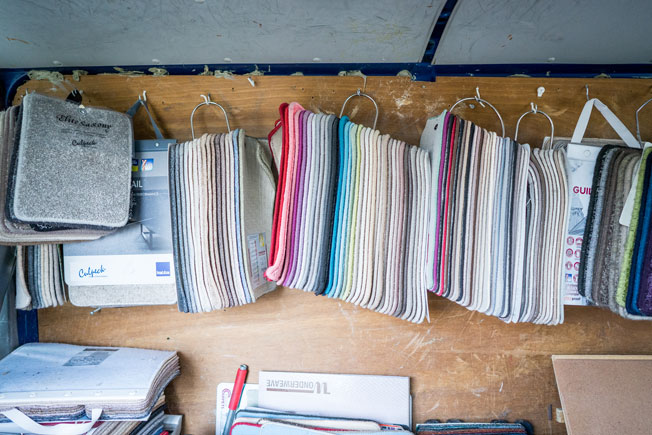
While discussing materials, it is also worth checking what extras will be used as well as the visible carpet - what will they be doing in terms of underlay and carpet grippers? If you’re spending money on a good quality carpet, you shouldn’t scrimp on the extras just because they won’t be seen, and a quality tradesman will be able to explain the best products to use and why.
Get like-for-like quotes and make sure everything is included
It’s important to get a full quotation from a tradesman before work begins. The detail and scope of their quotation can tell you a lot about their process. If you get multiple quotations, which you may want to do for a larger job, it is important to make sure that all the quotations are like-for-like - do they include materials, labour, and VAT? The only way to accurately compare quotations is if you are comparing like-for-like.
Two particular issues to consider when having carpets fitted are the moving of furniture and the disposal of any previous flooring that is being removed. Some fitters may request that you clear out any room to be carpeted, however others will do this for you - though they may charge for the privilege. Some may request that all old carpet or flooring be removed before they come to install the new carpet, however, others will “uplift and remove”. Because tradesman have to pay for the moving and disposal of waste, this cost may be passed on to you - make sure it is covered in the quote if so. Brian said:
Removal has to be taken into consideration, because for us to dump rubbish now is a lot of money. Obviously if there’s old flooring it has to come up, and it has to go somewhere. I don’t mind either way, but it will cost more. However, most boroughs give free rubbish clearances occasionally for domestic use, or if they drive they can take it to a local dump free of charge. It’s up to the homeowner if that’s practical for them.
Brian Tilbury
If you have a larger job and are taking multiple quotations, a sample of at least three quotations can help you spot any that seem unreasonably low. If this is the case, it could be the sign of a tradesman who wants
 to win the job, but will make up the true value by adding on extra costs.
Establish a payment plan
After agreeing to a price through an accurate, written quotation, make sure you have a payment plan in place that you are comfortable with.
Generally, a reputable tradesman will not expect, or ask for, payment up front. Typically, carpet fitters will not expect a deposit either, though this may depend on the scale of the job - if you are also purchasing the carpet through them, they may charge something up to cover some of the costs and protect themselves against the job falling through. Many tradesmen will be happy to deal in cash, but most should now accept cheques or bank transfers, which allow you to keep a better record of the transaction. Peter said:
We never take a deposit, we feel that that’s their guarantee that they’re going to get a good job. Sometimes it can be a lot of money so we don’t ask for cash, we always ask for bank transfer. It suits everybody, it comes into your account straight away and neither party has to worry about it.
Peter Jewett, LifeStyle Trade Flooring
Brian added:
If I were to take a deposit, it would only be to cover the fact that once I order a carpet, I own it - even if it’s bought for the client and made to their measurements. If they then backed out of the job, I’d be left with a carpet I couldn’t use, so I’d be left out of pocket.
Brian Tilbury
Check if there will be follow-ups
Carpet jobs should be relatively uncomplicated, with little required in the way of aftercare. However, it is always worth asking the tradesman what aftercare service they can provide. If you do speak to previous clients for a reference, you can ask if they needed any follow-ups and how the tradesman dealt with it, in case you do have any questions or follow-ups of your own. Brian said:
I advise all clients as best I can when I finish a job - with a carpet, there isn’t too much that can go wrong, as long they keep it clean and look after it. But I tell everyone that they can always feel free to phone me up after if there’s anything I can come and help with.